A container unloaded at Mundra earns money for a port operator each time cargo moves through the terminal. A Jio broadband connection earns money month after month, provided the customer stays. Both businesses require substantial investment before the first bill can be raised. What differs is how the investment pays for itself. In FY 2025–26, the Adani portfolio spent more on capital projects than Reliance Industries, while Reliance reported higher operating earnings and faster earnings growth. The figures make more sense alongside the assets each group built, the customers those assets serve and the time it takes a new project to start earning.
What the Investment Figures Cover
Adani reports capital expenditure across a portfolio of companies. Reliance Industries reports it for a listed parent and its consolidated businesses. Both totals cover spending during FY 2025–26. A proposed investment or a project’s entire lifetime budget belongs outside this comparison.
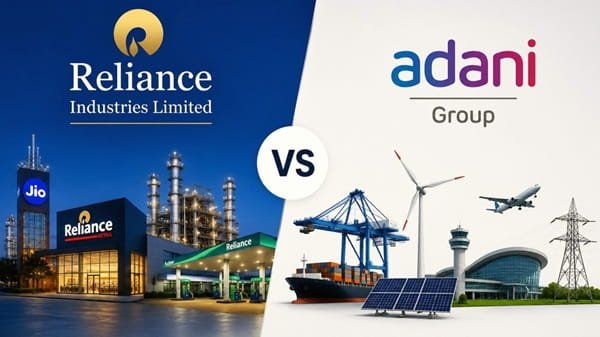
Adani and Reliance at a Glance
| Measure | Adani Group | Reliance Industries (RIL) |
| Capital expenditure | ₹1,52,967 crore across the portfolio | ₹1,44,271 crore on a consolidated basis |
| Reported EBITDA growth | 5.6% over FY 2024–25 | 13.4% over FY 2024–25 |
| Where investment went | Energy, utilities, transport and logistics | Oil-to-chemicals, new energy, digital services and retail |
| Evidence of demand | Cargo handled, electricity supplied and use of transport assets | Subscribers, retail transactions and sales of fuels and chemicals |
₹1 lakh crore equals ₹1,00,000 crore. EBITDA is earnings before interest, tax, depreciation and amortisation.
How the Businesses Are Organised
The Adani name covers several companies with separate accounts. Adani Ports and Special Economic Zone (APSEZ) operates ports and logistics assets. Adani Green Energy develops renewable power projects, while Adani Energy Solutions operates transmission and distribution businesses. Adani Enterprises develops newer businesses, including airports. A shareholder in the port company therefore has a different interest from someone who owns shares in Adani Enterprises.
Reliance brings refining, petrochemicals, exploration, digital services and retail together under RIL. Its consolidated results include controlled subsidiaries such as Jio Platforms and Reliance Retail Ventures. This comparison uses that reporting boundary throughout. The separately controlled Anil Ambani businesses fall outside it. The distinction matters particularly in power and infrastructure, where a company with “Reliance” in its name can easily be assigned to the wrong group.
Where Adani Put Its Capital
Nearly four-fifths of Adani’s FY 2025–26 investment went into its core infrastructure businesses. Some of that spending added capacity to existing networks. Some established new facilities that had only a short operating record by the end of March. Three projects illustrate the difference.
- Renewable power. Adani Green added 5.1 gigawatts during the year, taking operational capacity to 19.3 GW. A completed solar or wind project begins to earn from electricity delivered. Its annual output depends on the resource available and the ability of the grid to take the power.
- Navi Mumbai International Airport began operations in December 2025. Its construction represented a major commitment before opening, but FY 2025–26 captured only the first few months of traffic. The number of flights airlines schedule will influence how quickly the terminal fills.
- APSEZ completed its acquisition of Australia’s North Queensland Export Terminal in December 2025. Buying a working terminal brings existing facilities into the portfolio. Building a port from scratch requires the operator to develop traffic as well as berths and handling equipment.
Those investments have different payback periods. Even within a single airport, a completed runway earns little from an airline that has yet to start its route, while a busy terminal can generate both aeronautical fees and income from shops. For that reason, the first full year of operation is often more informative than the quarter in which construction ends.
Where Reliance Put Its Capital
RIL increased annual capital expenditure from ₹1,31,107 crore in FY 2024–25 to ₹1,44,271 crore in FY 2025–26. Its annual report identifies oil-to-chemicals and new energy as principal investment areas, alongside continued spending on digital services and retail. An improvement at an existing refinery, an extension to a broadband network and a new store all enter the investment total. Each has a different test of commercial success.
Consider broadband. Laying fibre down a street makes service available to the buildings it passes. Earnings depend on how many households take a connection, the tariff they pay and how long they stay. Jio ended March 2026 with more than 52.4 crore total subscribers across its services. That customer base helps explain the attraction of investing in network capacity, though it cannot tell a reader how many homes subscribed along one new fibre route.
Reliance Retail ended the year with 20,160 stores. A new outlet can attract shoppers and support local deliveries, but it also brings rent, staff costs and stock that must sell. A store count shows distribution reach. Sales from established stores and transactions across the network help explain whether that reach is translating into demand.
Which Group Grew Faster?
Adani reported FY 2025–26 portfolio EBITDA of ₹94,834 crore, up 5.6%. Core infrastructure contributed 87% of that figure. RIL reported consolidated EBITDA of ₹2,07,911 crore, up 13.4%. On their respective published measures, Reliance recorded the faster increase. Adani’s portfolio calculation adjusts for items including exceptional charges and foreign-exchange gains or losses, so treating the two EBITDA totals as identical accounting measures would overstate the precision of the comparison.
Operating results add detail that the earnings figures miss. APSEZ handled 500.8 million tonnes of cargo, up 11%. At RIL, oil-to-chemicals remained the largest segment by revenue at ₹6,62,401 crore. A port can earn more by handling more tonnes, or by handling cargo that commands different charges. A refiner’s earnings depend on the spread between the cost of crude and the prices of the fuels and chemicals it sells. Higher turnover need not mean that spread improved.
How Borrowing Affects the Next Project
Adani reported year-end net debt of 3.3 times portfolio EBITDA. For an infrastructure developer, that ratio matters because construction bills and interest payments can arrive years before traffic or power sales settle into a regular pattern. A delay at a project can extend the period during which the company needs funding without adding the expected operating income.
Reliance said cash profits covered its FY 2025–26 capital expenditure and reported consolidated net debt of ₹1,24,717 crore at year-end. Its established refinery, telecom and retail businesses give the parent several sources of earnings as it builds new facilities. The timing still matters. A factory under construction absorbs money today, whereas its contribution to cash flow depends on commissioning, production quality and customer orders.
Who Led on Investment and Growth?
Adani’s reported capital expenditure exceeded RIL’s by ₹8,696 crore. Reliance, meanwhile, grew reported EBITDA faster and earned considerably more on that measure over the same year. For Adani, the next test is how much traffic, cargo and electricity the expanded infrastructure can support. For Reliance, it is whether investment in industrial facilities and consumer networks generates enough additional sales and earnings to justify the cost.
Frequently Asked Questions
Q. Does Adani Enterprises’ capital expenditure represent the entire Adani Group?
No. Ports, renewable power and transmission have separately reported businesses. The portfolio figure is the appropriate starting point for group-wide investment. The Adani Enterprises figure answers a narrower question about the businesses in its own accounts.
Q. Can the ₹8,696 crore spending gap be read as a profit lead?
No. Capital expenditure buys or builds long-lived assets. Profit depends on subsequent revenue, operating costs, financing and depreciation. A company can spend more in a particular year precisely because several large projects have yet to generate a full year of income.
Q. Where are Adani and Reliance closest as competitors?
Solar manufacturing is one area of overlap. The practical comparison is between equivalent products, such as modules, and their actual production or sales. Comparing Adani Green’s operating power capacity with a Reliance factory’s module capacity would mix electricity generation with equipment manufacturing.
Q. Does an airport opening count as a full year of growth?
Only the traffic and income after opening enter that year’s operating record. Navi Mumbai’s December opening gave it roughly one quarter within FY 2025–26. An assessment of demand should allow for the phased arrival of flights and passengers.