Successful trading is not just about predicting whether stock prices will rise or fall. It also depends on how often your trades are profitable, how much you gain when you win, and how much you lose when a trade goes against you. Two important concepts that help traders evaluate their strategies are win rate and risk-reward ratio.
Some traders focus on achieving a high win rate, while others prefer strategies that offer larger potential profits relative to potential losses. However, neither metric can determine trading success on its own. Understanding how they work together can help traders make better decisions in the Indian stock market and other financial markets.
What Is Win Rate in Trading?
Win rate is the percentage of completed trades that result in a profit. It helps traders understand how frequently their trading strategy produces winning outcomes.
The formula for calculating win rate is:
Win Rate = (Number of Winning Trades ÷ Total Number of Trades) × 100
For example, suppose you complete 100 trades, of which 60 are profitable and 40 are losing trades. Your win rate is 60%.
A high win rate may indicate that a strategy frequently identifies favourable opportunities. However, it does not automatically mean that the strategy is profitable overall.
Consider a trader who earns ₹500 on each winning trade but loses ₹1,000 on each losing trade. If the trader wins 60 trades and loses 40 trades, the total profit is ₹30,000, while the total loss is ₹40,000. The result is a net loss of ₹10,000 before trading costs.
This example shows why traders should evaluate both the frequency and size of their gains and losses.
What Is the Risk-Reward Ratio?
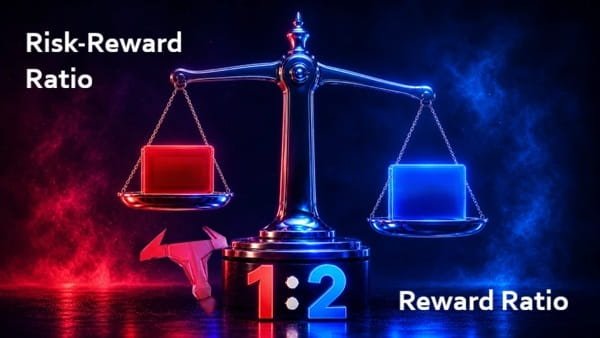
The risk-reward ratio compares the amount a trader is willing to risk on a trade with the potential profit they expect to make.
For example, if you risk ₹1,000 to target a potential profit of ₹2,000, your risk-reward ratio is 1:2. This means the potential reward is twice the amount at risk.
Similarly, risking ₹1,000 for a potential profit of ₹3,000 represents a 1:3 risk-reward ratio.
A favourable risk-reward ratio can allow a strategy to remain profitable even if several trades result in losses. However, a larger target does not guarantee that the market will reach it.
The risk-reward ratio is usually estimated before entering a trade. Actual results may differ because of slippage, price gaps, execution conditions, and changes in market behaviour.
Win Rate vs Risk-Reward Ratio: Key Differences
| Factor | Win Rate | Risk-Reward Ratio |
| Meaning | Percentage of trades that are profitable | Potential reward compared with potential risk |
| Primary focus | Frequency of winning trades | Size of potential gains relative to losses |
| High value indicates | More trades are profitable | Larger potential reward per unit of risk |
| Main limitation | Does not show the size of wins and losses | Does not guarantee the target will be reached |
| Useful for | Evaluating trade outcomes | Planning entries, stop-losses, and profit targets |
| Best used with | Average win, average loss, and trading costs | Win rate, execution quality, and actual results |
Both metrics provide useful information, but neither should be evaluated in isolation.
Understanding the Break-Even Win Rate
One of the most useful ways to combine win rate and risk-reward ratio is to calculate the break-even win rate. This is the percentage of winning trades required to cover losing trades before costs, assuming consistent average wins and losses.
The formula is:
Break-Even Win Rate = Risk ÷ (Risk + Reward) × 100
Suppose you risk ₹1,000 to target ₹2,000. Your risk-reward ratio is 1:2.
The break-even win rate is:
₹1,000 ÷ (₹1,000 + ₹2,000) × 100 = 33.33%
This means you need to win approximately 33.33% of trades to break even before trading costs, assuming every winning trade earns ₹2,000 and every losing trade loses ₹1,000.
For a 1:1 risk-reward ratio, the break-even win rate is 50%. For a 1:3 ratio, it is 25%.
These figures are mathematical estimates, not predictions. Actual trading costs increase the win rate required to break even, and real trades rarely produce perfectly consistent outcomes.
Which Matters More: Win Rate or Risk-Reward Ratio?
Neither metric is universally more important. The right balance depends on the strategy, market conditions, execution, and the trader’s ability to follow a plan.
A strategy with a high win rate may still lose money if its occasional losses are much larger than its typical gains. Conversely, a strategy with a lower win rate may be profitable if its winning trades generate sufficiently larger gains than its losing trades.
For example, consider two hypothetical traders who each complete 100 trades.
| Metric | Trader A | Trader B |
| Winning trades | 70 | 40 |
| Average profit per winning trade | ₹500 | ₹2,000 |
| Losing trades | 30 | 60 |
| Average loss per losing trade | ₹1,500 | ₹500 |
| Total profit from winning trades | ₹35,000 | ₹80,000 |
| Total losses | ₹45,000 | ₹30,000 |
| Net result before costs | -₹10,000 | ₹50,000 |
Trader A wins more frequently but loses money overall. Trader B has a lower win rate but produces a positive result because the average winning trade is substantially larger than the average losing trade.
The example demonstrates that profitability depends on the relationship between win rate and average gains and losses.
How Traders Can Improve Their Trading Performance
Instead of chasing a high win rate or an impressive risk-reward ratio, traders should focus on developing a consistent and measurable strategy.
- Define risk before entering: Identify a reasonable exit point if the trade moves against you.
- Set realistic profit targets: Avoid choosing distant targets merely to make the risk-reward ratio look attractive.
- Maintain a trading journal: Record entry prices, exit prices, reasons for trading, and actual gains or losses.
- Include trading costs: Account for brokerage, Securities Transaction Tax, exchange charges, and other applicable expenses.
- Review enough trades: Evaluate performance over a meaningful sample rather than judging a strategy by a few wins.
- Control position size: Avoid risking an excessive proportion of your capital on one trade.
Traders should also remember that stop-loss orders do not guarantee execution at the specified price, particularly during sudden market movements or price gaps.
Conclusion
Win rate and risk-reward ratio are both essential tools for evaluating trading performance. Win rate shows how frequently trades produce profits, while the risk-reward ratio helps assess potential gains relative to potential losses.
A high win rate cannot compensate for every poorly controlled loss, and an attractive risk-reward ratio is not useful if profit targets are rarely achieved. The most effective approach is to evaluate both metrics alongside average trade outcomes, transaction costs, and disciplined risk management.
For traders in India, understanding this relationship can support more realistic expectations and better trading decisions. Ultimately, consistent performance matters more than winning every trade.
Frequently Asked Questions
Q. Is a 70% win rate good in trading?
A 70% win rate can be promising, but it does not guarantee profitability. Average gains, average losses, transaction costs, and the reliability of the trading strategy also matter.
Q. What is a good risk-reward ratio for beginners?
Some traders use ratios such as 1:2 as a planning guideline, but no single ratio suits every strategy. The target should be realistic for the instrument and market conditions.
Q. Can a trader be profitable with a 30% win rate?
Yes. A 30% win rate can be profitable if average winning trades are sufficiently larger than average losing trades and the results remain positive after costs.
Q. Should beginners focus more on win rate or risk-reward ratio?
Beginners should understand both. They should first learn to manage losses, plan trades realistically, and evaluate actual results rather than focusing on winning frequently.
Q. Does a higher risk-reward ratio guarantee better trading results?
No. A higher potential reward often comes with a lower probability of reaching the target. Traders should evaluate whether their strategy can achieve the intended outcomes consistently.