The Indian stock market offers different ways to participate in price movements, but two common options are equity trading and Futures and Options (F&O) trading. Both can provide opportunities to earn returns, yet they differ significantly in ownership, capital requirements, complexity, and potential losses.
Equity trading involves buying and selling shares of listed companies, while F&O trading involves contracts whose value depends on an underlying asset, such as a stock or market index. Although both carry market risk, F&O trading can expose retail investors to additional risks because of leverage, contract expiry, and complex pricing behaviour.
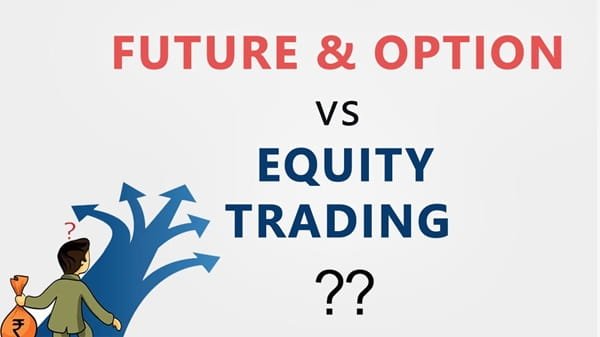
Understanding the differences between equity and F&O trading can help investors choose an approach that matches their financial goals, experience, and risk tolerance.
What Is Equity Trading?
Equity trading involves buying and selling shares of publicly listed companies through a stock exchange. When you purchase shares through a delivery-based transaction, you generally become a shareholder after the applicable settlement process.
For example, suppose you buy 20 shares of a company at ₹500 each. Your investment is ₹10,000, excluding transaction charges. If the share price rises to ₹550, your holding becomes worth ₹11,000. If it falls to ₹450, its value declines to ₹9,000.
Your gain or loss depends on the share price, the number of shares held, and applicable costs. In a fully paid delivery purchase, you generally do not face a margin call simply because the share price falls, although your investment can lose substantial value.
Equity trading includes short-term trading as well as long-term investing. Investors may analyse company earnings, financial statements, industry conditions, valuation, and market trends before making decisions.
However, equity trading is not risk-free. A company may experience declining profits, rising debt, poor management decisions, or other problems that cause its share price to fall.
What Is F&O Trading?
F&O stands for Futures and Options. These are derivative contracts whose value is linked to an underlying asset, such as a company’s shares or a stock market index.
A futures contract generally creates an obligation to buy or sell the underlying asset or settle the contract according to its terms. An options contract gives the buyer a right, but not an obligation, to buy or sell the underlying asset under specified conditions. Options sellers have corresponding contractual obligations.
For example, a trader may buy a call option on a stock or index because they expect its price to rise. The option’s value depends not only on the underlying price but also on factors such as time remaining until expiry, volatility, and other pricing variables.
F&O contracts often provide substantial exposure relative to the initial margin or premium committed. This can magnify gains, but it can also magnify losses relative to the capital used.
F&O trading is commonly used for speculation and hedging. However, understanding contract specifications, margin requirements, expiry dates, and settlement rules is essential before entering a position.
Equity Trading vs F&O Trading: Key Differences
| Feature | Equity Trading | F&O Trading |
| What is traded? | Shares of listed companies | Futures and options contracts |
| Ownership | Delivery purchases provide share ownership | Derivatives generally do not provide ownership of the underlying shares |
| Capital requirement | Delivery purchases generally require the purchase amount | Depends on the contract, premium, and margin requirements |
| Leverage | Generally not required for fully funded delivery purchases | Often involves leveraged exposure |
| Expiry | Shares do not have a contract expiry date | Contracts have defined expiry dates or terms |
| Risk factors | Share price declines and company-specific risks | Market movements, leverage, volatility, expiry, and margin requirements |
| Complexity | Generally easier to understand | Requires knowledge of contract pricing and settlement |
| Potential losses | Can be substantial; fully paid shares can lose most or all of their value | Depends on the strategy; some positions can incur losses exceeding the initial amount committed |
Why Can F&O Trading Be Riskier?
F&O trading can be riskier for retail investors because it combines market exposure with additional factors that may accelerate losses.
Leverage can magnify losses: A relatively small initial margin can provide exposure to a much larger position. Even a modest adverse price movement may therefore cause a significant loss relative to the capital committed.
Options can lose value over time: Options have expiry dates, and their value can decline as expiry approaches, all else being equal. An options buyer can lose the entire premium paid if the contract expires worthless.
Futures can create substantial obligations: Futures traders face gains and losses as the underlying price changes. Adverse movements may require additional margin, and losses can exceed the initial margin deposited.
Expiry adds complexity: Derivative contracts have specific expiry and settlement conditions. Traders who do not understand these requirements may face unexpected obligations or losses.
Volatility can change option prices: An option’s value depends on more than the direction of the underlying asset. Changes in implied volatility, time remaining, and other pricing factors can affect its price.
These risks do not mean every F&O trade is riskier than every equity trade. Risk depends on the particular security, contract, position size, and strategy. However, the additional complexity makes F&O unsuitable for many inexperienced traders.
Advantages and Risks of Equity Trading
Equity trading can be more straightforward for retail investors who want to understand the businesses they own.
Advantages:
- Delivery-based purchases allow investors to hold shares for the long term.
- Investors can analyse company earnings, management, and financial health.
- Fully funded purchases avoid borrowing-related margin calls associated with leveraged positions.
- Shares do not expire like derivatives contracts.
Risks:
- Share prices can decline sharply because of company-specific or broader market events.
- Poor investment decisions and excessive concentration can lead to significant losses.
- Short-term equity trading can still involve volatility, transaction costs, and emotional decision-making.
For beginners, fully funded delivery-based investing may offer a more manageable way to learn about financial markets, provided they understand that share prices can fall substantially.
Can F&O Trading Be Used to Reduce Risk?
Yes. Although derivatives can increase risk, they can also help investors manage certain risks when used appropriately.
For example, an investor holding a diversified equity portfolio may use an eligible index derivative strategy to hedge some market exposure. If the market falls, gains on the hedge may partially offset losses in the portfolio.
However, hedging is not guaranteed to work perfectly. Differences between the portfolio and the derivative, changes in volatility, transaction costs, and contract expiry can affect the outcome.
Options strategies also have different risk profiles. Buying a call or put generally limits the buyer’s maximum loss to the premium paid, excluding applicable costs. By contrast, some options-selling strategies can involve very large or theoretically unlimited losses.
Therefore, investors should understand the complete payoff structure before using derivatives for speculation or hedging.
Which Is Better for Retail Investors?
For most beginners, fully funded equity investing is generally easier to understand than F&O trading. Investors can begin by learning about company fundamentals, valuation, diversification, and long-term portfolio management without dealing with contract expiry or complex derivative pricing.
F&O trading may be appropriate for experienced participants who understand leverage, volatility, margin requirements, and the risks of each strategy. It may also serve a specific hedging purpose for investors who understand how derivatives interact with their existing portfolios.
Before trading either market, investors should consider their financial goals, available capital, experience, and ability to absorb losses. Borrowing money to speculate or using emergency savings for leveraged trades can create serious financial difficulties.
Risk Management Tips for Retail Investors
Regardless of the market you choose, a disciplined approach is essential.
- Start with education: Understand the instrument, order types, charges, and settlement rules before trading.
- Avoid excessive leverage: Do not increase exposure simply because a broker permits a larger position.
- Set position limits: Decide how much capital you are willing to risk on an individual trade.
- Understand the worst-case scenario: Review potential losses, margin requirements, and contract obligations before entering F&O positions.
- Diversify investments: Avoid concentrating your entire portfolio in one stock, sector, or trading strategy.
- Track actual performance: Include brokerage, taxes, financing charges, and other applicable costs when evaluating returns.
Conclusion
Equity trading and F&O trading both involve market risk, but F&O trading introduces additional complexities through leverage, contract expiry, margin requirements, and derivatives pricing. These factors can cause losses to accumulate quickly, making F&O particularly challenging for inexperienced retail investors.
For most beginners, fully funded equity investing is generally the more accessible starting point. F&O trading should be considered only after developing a strong understanding of derivatives and their potential risks.
Ultimately, the appropriate choice depends on your financial objectives, experience, and risk tolerance. No trading method guarantees profits, and protecting your financial stability should take priority over pursuing quick returns.
Frequently Asked Questions
Q. Is F&O trading riskier than equity trading?
F&O trading often carries additional risks because of leverage, expiry, and complex pricing. However, the actual risk depends on the instrument, position size, and strategy.
Q. Can retail investors lose more than their initial investment in F&O?
Yes. Some futures and options strategies can produce losses greater than the initial margin or amount committed. Certain options-buying positions have a maximum loss limited to the premium paid, excluding applicable costs.
Q. Is equity trading suitable for beginners?
Fully funded delivery-based equity investing is often easier for beginners to understand. However, investors must still research companies, manage concentration risk, and accept the possibility of losing money.
Q. Can F&O trading generate regular income?
F&O trading does not guarantee regular income. Market movements are unpredictable, and leverage, transaction costs, and adverse price changes can lead to substantial losses.
Q. Should beginners avoid F&O trading completely?
Beginners should generally prioritise learning and risk management before considering F&O trading. Understanding derivatives, contract specifications, margin requirements, and potential losses is essential before committing money.