Choosing the right mutual fund option is an important part of building an effective investment strategy. In India, mutual fund investors commonly choose between the Growth option and the Income Distribution cum Capital Withdrawal (IDCW) option. Both options can invest in the same underlying mutual fund scheme, but they differ in how investment gains are handled and how investors receive money.
The Growth option generally focuses on increasing the investment’s value over time, while the IDCW option allows investors to receive distributions when declared by the mutual fund, subject to available distributable surplus and applicable rules.
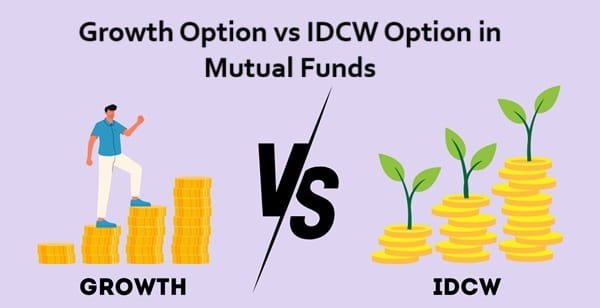
Understanding these differences can help you select an option that matches your financial goals, investment horizon, and need for regular cash flow.
What Is the Growth Option in Mutual Funds?
Under the Growth option, the mutual fund does not distribute income to investors through periodic IDCW payouts. Instead, gains and income generated by the scheme remain within the fund and contribute to its net asset value (NAV), after expenses and other adjustments.
For example, suppose you invest ₹1,00,000 in a mutual fund’s Growth option. If the investment’s NAV rises by 10%, your investment value becomes approximately ₹1,10,000, assuming no other changes affect the calculation.
Your investment can benefit from compounding because returns generated within the scheme remain invested. However, returns are not guaranteed, and the NAV can fall when market conditions or the scheme’s underlying investments perform poorly.
The Growth option is often suitable for investors who want to accumulate wealth over several years rather than receive regular distributions. It can be particularly relevant for long-term goals such as retirement, children’s education, or building a financial corpus.
What Is the IDCW Option in Mutual Funds?
IDCW stands for Income Distribution cum Capital Withdrawal. It replaced the earlier term “dividend option” in mutual funds to clarify that distributions may include income and capital, rather than representing guaranteed profits.
Under the IDCW option, a mutual fund may distribute money to investors when a distribution is declared. The amount and frequency are not guaranteed, and a distribution depends on the scheme’s applicable rules and available distributable surplus.
For example, suppose you invest ₹1,00,000 in a mutual fund and receive an IDCW distribution of ₹3,000. The amount you receive is ₹3,000 before any applicable tax deduction. However, the scheme’s NAV generally falls by an amount corresponding to the distribution, adjusted for market movements and other factors.
This means an IDCW payout is not additional profit created simply by distributing money. Investors should evaluate the total return, including both distributions received and the remaining investment value.
The IDCW option may appeal to investors who prefer receiving cash from their investments, but it should not be treated as a guaranteed source of income.
Growth Option vs IDCW Option: Key Differences
| Feature | Growth Option | IDCW Option |
| Treatment of gains | Gains remain invested within the scheme | Distributions may be paid when declared |
| Regular cash flow | No periodic IDCW payouts | Potential payouts, but not guaranteed |
| Compounding | Gains can remain invested and compound | Distributions reduce the amount remaining invested |
| NAV | Reflects investment performance and expenses | Generally adjusts downward when a distribution is made |
| Investor control | Investors decide when to redeem units | Investors receive distributions when declared |
| Tax treatment | Tax generally arises when units are redeemed or otherwise taxed under applicable rules | Distributions are generally taxable in the investor’s hands |
| Suitable for | Long-term wealth accumulation | Investors who prefer potential cash distributions |
Both options can be available within the same mutual fund scheme. The underlying portfolio and investment objective are generally the same, but the treatment of distributions and resulting NAV differ.
Which Option Is Better for Long-Term Wealth Creation?
For investors focused on long-term wealth creation, the Growth option is often the more straightforward choice.
Because gains remain invested, the investor can benefit from compounding without withdrawing money through IDCW distributions. This may be useful when saving for goals that are several years away.
For example, someone investing monthly for retirement may prefer the Growth option because the primary objective is to build a larger corpus over time rather than receive cash payouts today.
However, the Growth option does not guarantee higher returns in every situation. The scheme’s performance, expense ratio, investment strategy, and market conditions remain important. Investors should select a suitable fund category before deciding between Growth and IDCW.
Which Option Is Better for Regular Income?
The IDCW option may suit investors who prefer receiving cash distributions from their mutual fund holdings. However, distributions are not assured, and the amount can vary.
Retirees or other investors seeking regular cash flow should understand that an IDCW distribution is not the same as interest from a fixed deposit or a guaranteed pension payment.
An alternative is the Growth option combined with a systematic withdrawal plan (SWP). Under an SWP, the investor requests periodic redemptions of a specified amount or number of units. This can provide more control over withdrawal timing, although the withdrawals may reduce the investment corpus and can involve capital gains tax.
The suitability of an SWP or IDCW depends on the investor’s income needs, tax situation, investment horizon, and tolerance for fluctuations in portfolio value.
Taxation: Growth vs IDCW
Tax treatment is an important consideration when comparing the two options in India.
IDCW distributions are generally taxable in the investor’s hands according to the applicable income-tax rules and tax slab. Tax may also be deducted at source when the relevant statutory conditions are met.
Under the Growth option, tax generally becomes relevant when units are redeemed and a capital gain or loss arises, subject to the applicable rules. The tax rate depends on factors such as the type of mutual fund, holding period, and current tax legislation.
Equity-oriented funds and debt-oriented funds may have different tax treatments. Rules can also change, so investors should check the tax provisions applicable to their specific scheme and transaction before making a decision.
How to Choose Between Growth and IDCW
Before selecting an option, consider the following factors:
- Your investment goal: Choose Growth when your priority is long-term accumulation and IDCW when you prefer potential distributions.
- Your need for cash: If you need predictable cash flow, examine whether IDCW distributions are sufficiently reliable for your requirements; they are not guaranteed.
- Tax implications: Compare the tax treatment of distributions and redemptions based on your circumstances.
- Investment horizon: Long-term investors may benefit from keeping gains invested, while investors needing withdrawals should assess their cash-flow strategy.
- Risk tolerance: Both options remain exposed to the underlying scheme’s market risks.
Avoid choosing the IDCW option solely because a scheme has recently declared a large distribution. A payout does not necessarily indicate superior performance or a better investment.
Conclusion
The Growth and IDCW options serve different investor needs. The Growth option is generally suitable for long-term wealth accumulation because gains remain invested, allowing compounding to work over time. The IDCW option may suit investors who prefer receiving distributions, but those payments are neither guaranteed nor necessarily equivalent to investment profits.
For most investors whose main objective is to build a corpus, the Growth option is often the simpler choice. Investors who need cash flow should compare IDCW with alternatives such as an SWP, taking tax and market risks into account.
Ultimately, choose the option that fits your financial goals rather than focusing only on payouts or past returns.
Frequently Asked Questions
Q. Is the Growth option better than IDCW?
The Growth option is often suitable for long-term wealth creation, while IDCW may appeal to investors who prefer potential cash distributions. The better choice depends on your financial goals.
Q. Does the IDCW option guarantee monthly income?
No. IDCW distributions are not guaranteed. Their frequency and amount depend on whether a distribution is declared under the scheme’s rules.
Q. Does the NAV fall after an IDCW payout?
Generally, yes. The NAV adjusts downward by an amount corresponding to the distribution, although market movements and other factors can also affect it.
Q. Is IDCW income tax-free in India?
Generally, no. IDCW distributions are taxable in the investor’s hands under applicable income-tax rules.
Q. Can I switch from IDCW to Growth?
Investors can generally switch between options where permitted by the scheme, but a switch may be treated as a redemption and a new investment. Capital gains tax and exit load may apply, so check the consequences before switching.