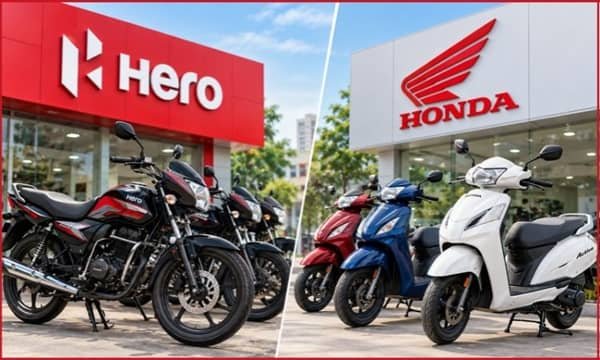
A family choosing a daily commuter motorcycle may compare a Hero Splendor with a Honda Shine. A city rider considering a scooter may instead place the Honda Activa beside Hero’s Destini or Xoom. These decisions look similar at a showroom, but they reveal different businesses behind the vehicles. Hero MotoCorp has built its scale around affordable motorcycles, a broad reach into smaller towns and rural markets, and increasingly a portfolio of premium bikes and VIDA electric scooters. Honda Motorcycle & Scooter India (HMSI) combines the enormous pulling power of the Activa with commuter motorcycles, premium models and a manufacturing and export operation connected to Honda’s wider global expertise.
The results for the year ended March 2026 underline how close the contest has become. Hero reported 64.69 lakh motorcycles and scooters sold, compared with 63.70 lakh units reported by HMSI, although their financial disclosure and product mix differ. Hero is a publicly listed Indian manufacturer with regular detailed earnings releases. HMSI is an unlisted Indian subsidiary of Honda Motor Co., meaning the Indian company’s annual sales volume is readily reported but a like-for-like listed-company earnings comparison cannot simply be constructed from Honda Motor’s global financial accounts. Understanding the difference between motorcycle leadership, scooter strength and corporate reporting matters more than choosing a winner from one headline figure.
Scope of the Comparison
The comparison concerns Hero MotoCorp Limited and Honda Motorcycle & Scooter India Private Limited, not Honda Motor Co.’s entire worldwide automobile, motorcycle and financial-services group. FY 2025–26 manufacturer sales are wholesale dispatches, not the same measure as vehicle registrations.
Hero MotoCorp vs Honda Motorcycle at a Glance
| Measure | Hero MotoCorp | Honda Motorcycle |
| FY26 reported vehicle sales | 64.69 lakh motorcycles and scooters | 63.70 lakh motorcycles and scooters |
| FY26 annual revenue | ₹46,830 crore revenue from operations (Hero disclosure) | Not compared: HMSI is an unlisted subsidiary |
| Core business | Commuter and premium motorcycles; scooters; VIDA EVs | Activa-led scooters, commuter and premium motorcycles |
| Sales and distribution | Strong rural and semi-urban reach; extensive dealer network | Major urban and national reach; scooter-led brand strength |
| Group identity | Indian listed two-wheeler company | Indian subsidiary of Japan’s Honda Motor |
Figures refer to FY 2025–26 unless otherwise stated. Revenue, sales, production and capacity describe different measures.
How the Product Portfolios Differ
Hero’s franchise begins with high-volume practical motorcycles such as Splendor and HF Deluxe, and extends through Passion, Glamour, Xtreme, Xpulse and premium offerings. The company is not exclusively a low-cost commuter maker, but its affordable motorcycle base remains a distinctive strength. A buyer who values mileage, simple maintenance and access to service in a smaller town is often shopping in Hero’s strongest territory.
Honda’s Activa has shaped India’s automatic-scooter market, complemented by the Dio and other scooter variants. Shine and SP125 compete in the commuter motorcycle market, while the BigWing network addresses higher-capacity bikes. These products create different selling economics: scooters depend heavily on urban household demand and convenience, while mainstream motorcycles have a larger rural and utility component. The mix also changes parts demand and the kind of after-sales capacity dealers need.
What the FY26 Sales Figures Actually Show
Hero reported sales of 64.69 lakh units in FY26, compared with 58.99 lakh in FY25. Its stated growth was about 10%. HMSI reported 63,69,504 units, up about 9%, comprising 57,49,275 domestic units and 6,20,229 exports. The difference between their total reported volumes was just under one lakh units, but that difference should not be confused with their relative strength in each market segment.
Retail registrations offer another lens: dealer dispatches can temporarily outrun customer purchases when inventories rise, or trail them when dealers run down stock. Registration-based market share is therefore best measured from a common source for the same dates. The manufacturer sales figures in this comparison are useful for scale, while domestic retail registrations are more relevant for asking which brand customers actually bought in India.
Revenue, Ownership and Profitability
Hero disclosed ₹46,830 crore of FY26 revenue from operations, up from ₹40,756 crore, along with approximately ₹6,871 crore of EBITDA. A more premium product mix, exports, operating efficiency and material costs affect its earnings beyond the simple number of motorcycles sold. Vehicle sales growth does not mechanically create the same percentage growth in profit.
HMSI’s sales should not be paired with the worldwide revenue of Honda Motor Co. and described as an Indian comparison. Global Honda accounts cover cars, motorcycles and other activities in multiple markets. HMSI has its own private-company financial statements, but this article does not insert an unverified revenue or profit estimate into the table. The absence of a symmetric revenue row is a disclosure issue, not evidence that Honda’s Indian motorcycle business is small.
Distribution, Exports and After-Sales Economics
Hero’s extensive dealer and service reach is especially meaningful outside major cities, where spare-parts access and reliable maintenance can be decisive. Repeat service, replacement parts and financing partnerships can help sustain the customer relationship long after the first vehicle sale. Its export strategy also reduces exclusive reliance on the Indian commuter motorcycle cycle.
HMSI exports from its Indian factories as well as supplying the home market. Its FY26 export volume of roughly 6.20 lakh units made international deliveries a visible contributor to total unit sales. The company also benefits from Honda’s engineering capabilities and established scooter reputation. Nevertheless, individual dealers in both networks face local competition, inventory costs, financing conditions and customer demand that may differ sharply across districts.
Electric Scooters and Premiumisation
Both businesses must manage a transition in which fuel-efficient petrol two-wheelers continue to sell in large numbers while electric scooters gain buyers. Hero’s VIDA brand gives it an entry into electric mobility, though EV growth should be measured in registrations and recurring margins rather than treating all new-model announcements as realised volume. Honda’s Indian electric scooter effort similarly requires charging and battery support, service training and customer confidence.
Premium motorcycles can raise average selling prices but need a different marketing and dealership strategy from basic commuter models. Hero’s premium motorcycle offerings and Honda’s BigWing portfolio should be assessed by addressable market and actual deliveries, not by assuming one expensive motorcycle offsets many commuter sales.
Main Risks and Future Growth Drivers
Rural income, monsoon conditions, loan availability, fuel costs and replacement demand shape mass-market two-wheeler purchases. Competitive pricing from TVS, Bajaj, Suzuki and new EV specialists creates additional pressure. Product recalls, emission standards and distribution costs can also affect profitability independently of annual volumes.
Hero’s challenge is to protect its commuter leadership while broadening its portfolio profitably. HMSI’s is to preserve scooter strength while gaining share in motorcycles and managing changes in electric mobility. Both could sell more vehicles without improving margins if discounts or materials costs rise faster than average selling prices.
Conclusion
Hero MotoCorp remains particularly strong in mass-market motorcycles and its distribution reach, while HMSI has an exceptionally powerful scooter business and is a close competitor in overall volume. FY26 company-reported sales put Hero marginally ahead, but a sound judgement depends on whether the question is about motorcycles, scooters, India retail registrations, exports or profitability. The financial comparison must also respect HMSI’s private-company status.
Frequently Asked Questions
Q. Did Hero sell more two-wheelers than HMSI in FY26?
On the manufacturers’ reported total-sales figures, yes: Hero sold 64.69 lakh units against HMSI’s approximately 63.70 lakh. Domestic registrations and motorcycle-only sales are separate comparisons.
Q. Does Honda Motor’s global revenue represent HMSI’s revenue?
No. Honda Motor’s consolidated revenue includes businesses and markets far beyond the Indian motorcycle subsidiary.
Q. Is Hero mainly a scooter company?
No. Hero’s historical scale is driven mainly by commuter motorcycles, while it also sells conventional scooters and VIDA electric models.
Q. Are wholesale sales the same as market share?
Not necessarily. Manufacturer dispatches and registered retail purchases can differ; a proper market-share calculation needs a consistent dataset and period.