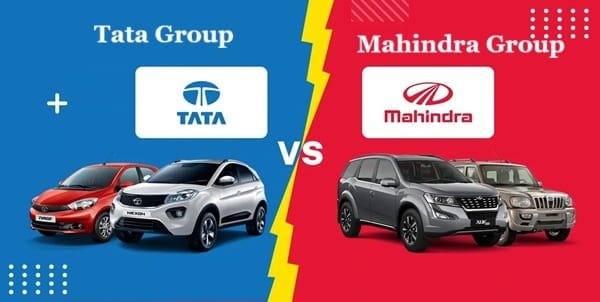
A farmer choosing a tractor and a bank choosing an IT services provider would see two very different rankings of Mahindra and Tata. Mahindra accounted for 43.6% of India’s tractor market in FY 2025–26. In IT services, Tata Consultancy Services earned nearly five times the annual revenue of Tech Mahindra. At group level, Tata is considerably larger, with businesses stretching from steel and airlines to jewellery and software. Mahindra’s strength shows up most clearly in markets where the customer has a specific job in mind, whether it is pulling a farm implement, buying a utility vehicle or financing a commercial pickup.
Which Revenue Figures Belong Together?
Mahindra’s group turnover includes Tech Mahindra. Tata’s figure is aggregate revenue across Tata companies. These are the most useful published measures of overall scale. The accounts of Mahindra & Mahindra alone or Tata Sons alone cover a different set of businesses.
Mahindra and Tata at a Glance
| Measure | Mahindra Group | Tata Group |
| FY 2025–26 group figure | About ₹2.6 lakh crore in turnover, including Tech Mahindra | ₹16.24 lakh crore in aggregate revenue across Tata companies |
| Vehicle businesses | SUVs, tractors, pickups, electric three-wheelers, trucks and buses | Passenger cars and SUVs, Jaguar Land Rover, trucks and buses |
| Technology services | Tech Mahindra reported revenue of about ₹56,815 crore | TCS reported revenue from operations of ₹2,67,021 crore |
| Other points of contact | Rural finance, logistics, holiday resorts and property | Steel, power, airlines, hotels, jewellery, apparel and electronics |
₹1 lakh crore equals ₹1,00,000 crore.
How Much Larger Is Tata?
Mahindra & Mahindra’s FY 2025–26 annual report describes the federation’s turnover as approximately ₹2.6 lakh crore. Tata Sons reports ₹16,24,030 crore in aggregate revenue across Tata companies for the same year. In round numbers Tata’s reported figure was a little over six times Mahindra’s. This is a group-level comparison using the companies’ own descriptions and Mahindra’s rounded turnover.
The distinction is particularly important for Mahindra. A reader who takes only the listed vehicle and tractor maker’s accounts misses the full scale of the federation. Tech Mahindra is an associate of M&M. Its entire revenue appears in the broader group turnover measure, while the parent’s consolidated accounts recognise its share of the associate’s earnings under the applicable accounting method. Adding Tech Mahindra’s sales to the ₹2.6 lakh crore total would count those sales again.
Tata has a similar naming problem for a different reason. Tata Sons is the principal investment holding company. A purchase from Trent’s Westside chain and an order for steel from Tata Steel belong to those operating companies. The Tata name on both businesses explains why the group reports an aggregate, but each company has its own shareholders and commercial priorities.
Where the Contest on Indian Roads Is Closest
SUVs provide the most visible point of competition. A household can compare a Mahindra XUV or Scorpio with a Tata SUV on price, seating, safety equipment, fuel choice and the service network in its district. In FY 2025–26 Mahindra reported a 25.3% share of Indian SUV revenue. That is a share of the money spent in the segment. A manufacturer selling a more expensive mix of vehicles can gain revenue share without gaining the same proportion of vehicles sold.
Tata’s automotive operation covers a different mix. Tata Motors Passenger Vehicles reported consolidated revenue from continuing operations of ₹3,35,582 crore in FY 2025–26, including Jaguar Land Rover. That figure reflects overseas luxury vehicle sales as well as Indian passenger vehicles. Tata’s commercial-vehicle business was separated during the year. For an Indian SUV comparison, domestic sales of comparable models are more revealing than a total that includes a Range Rover sold overseas.
Mahindra has a substantial goods-vehicle business of its own. It reported a 52.3% share in its Indian light commercial vehicle category below 3.5 tonnes during the year. An owner carrying vegetables from a mandi to neighbourhood shops will weigh payload, running cost and workshop access. A fleet buying large trucks for long-distance freight has different requirements. Leadership in pickups cannot settle a comparison spanning every class of commercial vehicle.
Why Tractors Matter to Mahindra
A tractor is bought primarily for the work it can do and the income it can support. Farmers compare horsepower, compatibility with implements and fuel use. The ability to get a replacement part during a short sowing window can carry as much weight as the original purchase price. A national dealer network matters because it has to work locally when a vehicle breaks down.
Mahindra reported that tractor volumes crossed 5 lakh in FY 2025–26, alongside its 43.6% domestic market share. The two figures describe different things. One counts the company’s volumes on its reported basis. The other places its domestic business within the Indian market. Tata’s interests in vehicles, steel and consumer goods give it exposure to the rural economy, but they do not give it an equivalent tractor franchise.
IT Services Give the Clearest Company Comparison
TCS and Tech Mahindra both sell technology services to enterprise clients, publish consolidated financial results and report for the same financial year. TCS earned ₹2,67,021 crore in revenue from operations in FY 2025–26, compared with about ₹56,815 crore for Tech Mahindra. The resulting ratio is about 4.7 to one. That is a cleaner size comparison than dividing global vehicle revenue by a competitor’s Indian SUV sales.
The purchasing decision looks different from a car purchase. A telecom operator hiring a technology partner may place a premium on experience with network systems. A bank moving critical software needs a provider able to keep services running throughout the migration. The larger firm can deploy considerable resources, but contract awards depend on expertise, price and responsibility for delivery as well as company size.
Where Their Other Businesses Reach Customers
- Financial services. Mahindra Finance reported assets under management of ₹1,34,096 crore at March 2026. Its vehicle and rural lending operations put the Mahindra name in touch with customers beyond the dealership. Tata Capital also participates in lending. A fair comparison would examine similar loan products, credit quality and the period-end loan book.
- Travel and hospitality. Club Mahindra sells holiday memberships that give members access to resorts under agreed terms. Tata’s Indian Hotels Company operates brands including Taj. A membership enrolment and an individual hotel booking represent different commitments from the customer.
- Industry and infrastructure. Tata Steel, Tata Power and Tata Electronics give Tata sizeable interests in industrial production and energy. Mahindra’s presence includes logistics, property and renewable-energy development. Its logistics company reported ₹6,999 crore in FY 2025–26 revenue.
Which Group Has the Wider Industry Presence?
Tata is larger by published group revenue and operates substantial businesses across more of the activities a household or company might buy. A customer can fly Air India, stay at a Taj hotel and hire TCS for a business contract. Mahindra’s smaller overall size sits alongside leading positions in Indian tractors and selected vehicle categories. The fairest conclusion depends on the purchase. Tata leads on overall scale, while a farmer looking for a tractor is in one of Mahindra’s strongest markets.
Frequently Asked Questions
Q. Is Mahindra’s SUV market share a percentage of all passenger cars sold?
No. The cited figure measures Indian SUV revenue, so both the vehicle category and the value basis matter. It cannot be read as a share of all passenger vehicles or even as the same percentage of SUV units sold.
Q. Why does Tata’s passenger-vehicle revenue include Jaguar Land Rover?
JLR falls within the passenger-vehicle company’s consolidated operations. Its sales count towards the company’s global revenue even when the buyer, dealership and vehicle delivery are outside India.
Q. Does Mahindra Finance’s loan book count as annual sales?
No. Assets under management measure the financing portfolio at a point in time. Revenue is earned over a period. Adding the loan book to annual group turnover would mix outstanding financing with income.
Q. Which figures are useful for comparing the groups in one industry?
For software, the two IT companies’ annual revenues use broadly comparable scopes. For vehicles, choose a domestic category and the same measure, such as SUV units or SUV revenue. For hotels, compare similar room inventories or occupancy measures after checking how each operator defines them.