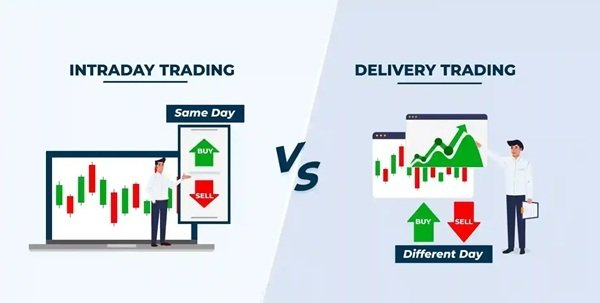
The Indian stock market offers different ways to buy and sell shares, but two common approaches are intraday trading and delivery trading. Both allow investors to participate in stock price movements, yet they differ in holding periods, risk management, time commitment, and investment objectives.
Intraday trading involves buying and selling shares within the same trading session, while delivery trading allows investors to hold purchased shares beyond the trading day. Understanding these differences is essential for beginners who want to choose an approach that suits their financial goals, available time, and risk tolerance.
Although intraday trading may appear attractive because of its potential for quick profits, it requires close monitoring and disciplined execution. Delivery trading is often easier for beginners to manage because it allows more time to research companies and make investment decisions.
What Is Intraday Trading?
Intraday trading is a trading approach in which a trader opens and closes a position during the same trading session. The objective is to benefit from short-term price movements rather than hold shares for several days or years.
For example, suppose a stock is trading at ₹500 in the morning. You purchase 100 shares and sell them later that day at ₹505. Your gross profit would be ₹500 before brokerage, taxes, and other applicable charges.
However, if the price falls to ₹495 and you sell at that level, your gross loss would be ₹500 before charges.
Intraday traders often use technical analysis, price charts, trading volume, and market news to identify potential opportunities. They must also monitor their positions closely because prices can change rapidly.
In India, brokers may offer specific intraday products, such as MIS, subject to their rules and applicable regulations. Positions may be automatically squared off if they remain open beyond the broker’s specified cut-off time.
Intraday trading requires a clear strategy, quick decision-making, and careful risk management. Frequent trading costs and emotional decisions can also affect overall performance.
What Is Delivery Trading?
Delivery trading involves purchasing shares and holding them beyond the current trading session. In a typical delivery-based equity purchase, the shares are credited to the investor’s demat account after the applicable settlement process.
For example, suppose you purchase 20 shares of a company at ₹500 each. Your total purchase value is ₹10,000, excluding transaction charges. You can generally hold those shares for weeks, months, or years, depending on your investment goals.
If the share price increases to ₹600, your holding would be worth ₹12,000. If the price falls to ₹400, its value would decline to ₹8,000. These figures exclude costs, taxes, and any dividends received.
Delivery trading is commonly used for long-term investing. Investors can research company fundamentals, assess valuations, and build diversified portfolios without needing to close every position on the same day.
However, delivery trading does not eliminate market risk. Share prices can decline substantially, and investors should avoid buying companies without understanding their financial position and business prospects.
Intraday Trading vs Delivery Trading: Key Differences
| Feature | Intraday Trading | Delivery Trading |
| Holding period | Positions are generally closed within the same session | Shares can be held beyond the trading day |
| Main objective | Benefit from short-term price movements | Trade or invest over a longer period |
| Time commitment | Usually requires frequent monitoring | Can require less daily monitoring |
| Trading frequency | Often involves frequent transactions | May involve fewer transactions |
| Analysis | Often relies on charts, momentum, and short-term market conditions | Often includes company fundamentals and valuation |
| Costs | Frequent trades can increase transaction costs | Costs depend on buying, selling, and applicable charges |
| Risk | Short-term volatility and rapid losses | Market declines and company-specific risks |
| Suitability for beginners | Requires substantial discipline and practice | Often more manageable for new investors |
Advantages of Intraday Trading
Intraday trading offers several potential advantages, although none guarantees profitability.
No intended overnight exposure: Traders generally close their positions before the trading session ends, avoiding exposure to overnight price changes on those closed positions.
Quick trading opportunities: Short-term price fluctuations may create opportunities to enter and exit positions during a single session.
Potential margin availability: Some brokers offer margin facilities for eligible intraday trades, subject to applicable rules. However, leverage can magnify losses and should not be confused with lower risk.
Immediate feedback: Traders can review their decisions and execution after each session, which may help improve a well-structured strategy.
Despite these benefits, intraday trading can be stressful. Sudden price movements, overtrading, and transaction costs can undermine results. Beginners should not assume that making multiple trades each day will produce regular income.
Advantages of Delivery Trading
Delivery trading may be more suitable for beginners who want to build investment experience gradually.
More time for research: Investors can study company performance, financial statements, and industry trends before making decisions.
Suitable for long-term goals: Delivery-based investing can support objectives such as wealth creation, retirement planning, and other long-term financial needs.
Less pressure to monitor prices continuously: Investors generally do not need to close their holdings at the end of each session.
Potential participation in dividends: Investors holding eligible shares may receive dividends when declared by the company, subject to the relevant record date and other conditions. Dividends are not guaranteed.
However, long-term investing still requires periodic portfolio reviews. Holding a declining stock indefinitely does not guarantee recovery, and investors should reconsider their decisions when company fundamentals change.
Which Is Better for Beginners?
For most beginners, delivery trading is often a more practical starting point, particularly when the goal is long-term wealth creation rather than frequent short-term profits.
Delivery trading gives new investors more time to understand how businesses operate, learn about valuation, and develop a disciplined investment approach. They can begin with an affordable amount and gradually build their knowledge.
Intraday trading may suit people who have sufficient time to monitor markets, understand technical analysis, and follow predefined risk limits. However, beginners should first practise with simulated trades and learn how transaction costs affect results.
The choice should depend on your financial circumstances and objectives. Avoid using emergency savings or borrowed money for speculative trading. No trading style guarantees profits, and even experienced traders can experience losses.
Tips for Beginners Before Starting
- Set clear goals: Decide whether you want to invest for the long term or trade short-term market movements.
- Start small: Use an amount that you can afford to expose to market risk.
- Learn order types: Understand market orders, limit orders, and stop-related orders before placing trades.
- Manage risk: Define your acceptable loss and position size before entering a trade.
- Understand costs: Brokerage, taxes, exchange charges, and other expenses can reduce returns.
- Avoid emotional decisions: Do not chase rapidly rising stocks or try to recover losses through impulsive trades.
Conclusion
Intraday trading and delivery trading serve different purposes. Intraday trading focuses on short-term price movements and requires frequent monitoring, quick decisions, and disciplined risk management. Delivery trading allows investors to hold shares beyond the trading session and is commonly used for longer-term investment goals.
For most beginners, delivery trading is often easier to manage while learning the basics of the stock market. Intraday trading may be considered after developing sufficient knowledge, experience, and a tested strategy.
Ultimately, the better approach is the one that fits your financial goals, available time, and risk tolerance. Research, patience, and disciplined decision-making are essential regardless of which method you choose.
Frequently Asked Questions
Q. Is intraday trading better than delivery trading?
Neither is universally better. Intraday trading focuses on short-term price movements, while delivery trading allows investors to hold shares longer. The suitable approach depends on your goals, experience, and risk tolerance.
Q. Is delivery trading safer for beginners?
Delivery trading avoids some risks associated with intraday leverage and forced square-offs, but share prices can still fall significantly. Investors should research companies and diversify appropriately.
Q. Can beginners earn daily income from intraday trading?
Intraday trading does not guarantee daily income. Prices can move unpredictably, and transaction costs can reduce profits. Beginners should avoid treating trading as a reliable source of immediate earnings.
Q. Do I need to monitor the market all day for delivery trading?
Not necessarily. Long-term investors may review their portfolios periodically rather than monitor every price movement. However, they should remain aware of important company developments and changes in their investment goals.
Q. Which trading method is suitable for long-term wealth creation?
Delivery-based investing in suitable securities can support long-term wealth creation, although returns are not guaranteed. Investors should consider company fundamentals, diversification, investment horizon, and their ability to tolerate losses.